In this edition Silvia shares her recent migration story to Australia, how she built a business around her passion, balancing health challenges, and why sometimes the best advice is simply: just do it.
Interview by Vasco Bontje
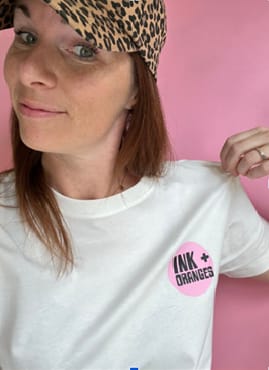
Can you introduce yourself and tell us how you and your family ended up moving from the south of the Netherlands to South Australia?
My name is Silvia, and I am from Brabant. We moved to South Australia three years ago because we wanted something different in life and wanted to experience living abroad. We had tried to make it happen in Europe before, but it never quite worked out. Then the opportunity to move to Australia came up.
We sold everything and had never even been to Australia. Because of my husband’s job, we could choose where we wanted to live, which can be difficult when you have never been to the country. We researched climate, city size, lifestyle and what people were like, and made a list of what we liked in the Netherlands and what we felt we were missing. Adelaide ticked the most boxes — and three years in, I can say it was absolutely the right call. I love it here
You said you sold basically everything you owned. That sounds like jumping in at the deep end, and into a country you did not know. How was that?
For us it did not feel as strange as it may have looked to others. It was something we really wanted, and we felt that if it did not work out, we could always go back. So it felt as though we had nothing to lose and only things to gain.
Australia also felt like a safe choice. It is English-speaking, Western, and we expected things such as healthcare and schooling to be good. Apart from being on the other side of the world, it did not feel extremely radical. It felt safe, but also like an adventure.
You briefly mentioned “things we did not have”. What did you mean by that?
In the Netherlands I often missed getting out at weekends and doing new things as a family. The climate made that harder; there were many months when I simply did not want to be outside. Here, better weather makes it much easier to go out, enjoy nature and step away from normal busyness.
We also go out for lunch, coffee or dinner more often. It feels more accessible here, and I really enjoy the Japanese, Vietnamese and Korean food in Adelaide.
How was the transition to life in South Australia for you and your family? And what do you miss from the Netherlands, or what have you started to see differently about the Dutch now that you live here?
The transition was actually quite good. We quickly found a house, found our way around, and the children started school. They had to learn English, of course, but they handled it very well. It took about six months before everything was properly arranged, but we never had a moment of thinking we had made the wrong decision.
I have also started to see the Dutch differently. We are very direct, while Australians are generally friendlier and more easy-going. I think living here has made me a bit kinder and more aware of how I communicate. In the first year I sometimes missed hearing Dutch around me, but that has faded, especially because we now have Dutch friends here too.
Why did you start your own business?
I have always been creative and interested in making things, but conventional employment was never really an option for me. During my graduation year I had a double herniated disc and couldn’t walk for months, and I was later diagnosed with fibromyalgia. Even simple jobs could lead to flare-ups that left me unable to work for extended periods, so I had to find a different way.
Running my own business meant I could work around my body instead of against it. I had already done that in the Netherlands, I ran a jewellery business for a while that went quite well, but after our second child it became too much to balance with family life.
When we moved to Australia, the idea of starting something new began to appeal again. I had been screen-printing for years, sewing clothes for my children and wanting large prints on sustainable fabrics. I kept hitting the same wall finding the materials I needed, so I thought — why not just make the kits available for other people too? It is something I genuinely love, and it solves a real problem.
I know you have an art degree. How has that creative background shaped what you do?
My degree was in spatial design, interior and furniture design, at the University of the Arts in Utrecht, so it wasn’t a fine arts background in the traditional sense. It was very much about how things exist in relation to each other: composition, proportion, how colours and materials sit together in a space.
That way of seeing has never left me. I’d describe myself more as a curator than a designer — I have a strong instinct for how things will combine, whether that’s colours, patterns, or ideas. I can look at elements that seem unrelated and immediately see how they’ll work together. That shows up constantly in what I do with Ink + Oranges, from the way I put kits together to how I think about what to print on and what goes with what.
Screenprinting is actually a perfect fit for that kind of thinking, because so much of it is about relationships; ink on fabric, pattern on object, colour on colour. It’s spatial design at a smaller scale, really.
So, your business is called Ink + Oranges. For people who do not know it, what exactly is it, and what makes you different from similar businesses?
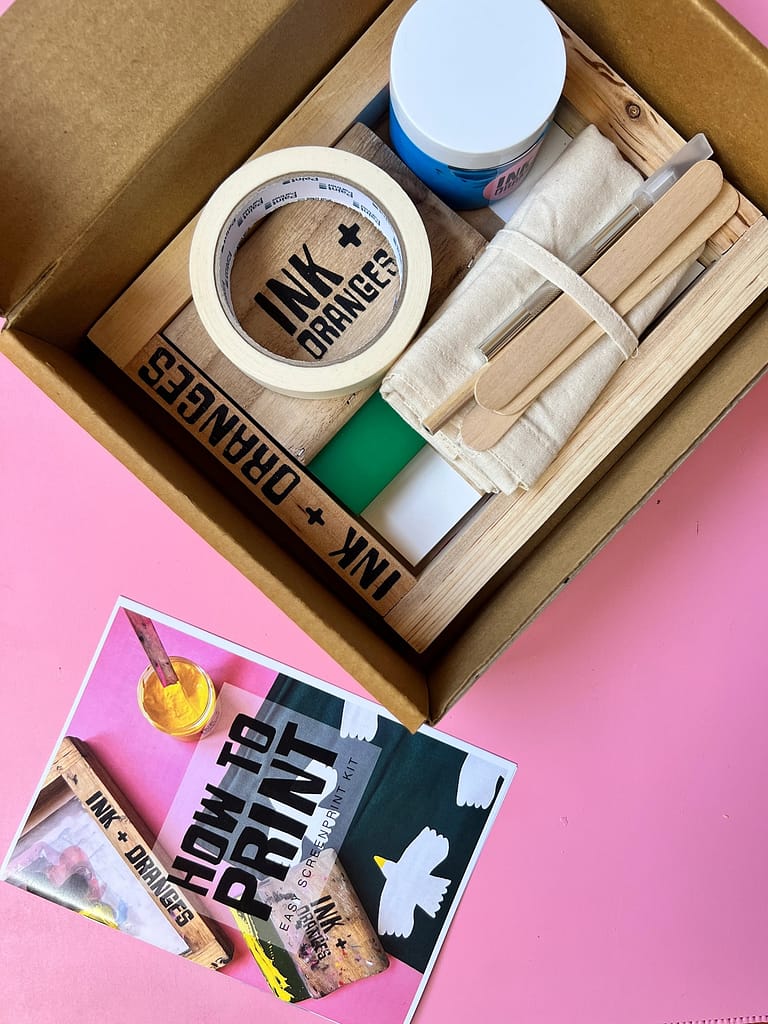
Ink + Oranges sells screen-printing kits designed for home use, no darkroom, no chemicals, no experience required. Traditional screen-printing involves emulsion, light exposure and a lot of preparation. My kits use stone paper stencils instead, so you can cut your own design, attach it to the screen and be printed within minutes.
Stone paper is waterproof, reusable and made without trees or water in production, so it’s a genuinely sustainable material, not just a marketing claim. You can swap designs on the same screen, which makes the whole system flexible and low-waste.
What really sets Ink + Oranges apart is that I’ve removed all the barriers that make people think screen-printing isn’t for them. If you can spread butter on toast, you can pull a print.
And now your entrepreneurial spirit has resurfaced in Australia. How do you combine your new business with your health constraints?
Because I work for myself, I can decide how many hours I work and how I structure my day. That freedom is essential. I can plan around my physical limits, the children, and the fact that some days are simply better than others. I don’t have a boss expecting me to show up when my body can’t manage it.
I’m also fortunate that the business doesn’t need to be our main income and that takes the pressure off and means I can grow it at a pace that works for me.
But I am genuinely proud of what I’ve built with Ink + Oranges. It’s growing, it brings in money, and it gives me real motivation and purpose, while still letting me work in a way that is sustainable for my body long-term.
Sustainability in your business is not just a concept. Are there any trade-offs you have to make in terms of sustainability?
There are real trade-offs, yes. Stone paper is harder to source than conventional stencil materials — I recently lost my supplier, and it took some serious scrambling through his connections to secure enough stock to last me the next five years. That’s not a comfortable position to be in, but it’s the reality of choosing materials that aren’t mainstream yet.
Making the screens myself also takes time I could spend elsewhere. But the ready-made options I found weren’t built to last, and longevity is sustainability. A screen that lasts a lifetime is always better than a cheap one you replace every year.
Where I’ve been able to design the trade-offs out entirely, I have. The kit box is also the shipping box, so there’s no double packaging. The inks are water-based, which is both the most sustainable option and the most practical for home use.
What has been your biggest learning curve so far in starting the business over here?
I mainly learn by doing. Because Ink + Oranges is mostly an e-commerce business, I have had to teach myself marketing: what works, what does not, and how to reach people. Social media is my strongest channel for finding new customers, but workshops have also helped build awareness.
I have also realised how important networking and word of mouth are. People need to get to know you, and workshops are a good way for that to happen.
Do you think your Dutch background influences the way you approach your business or life in Australia?
It undoubtedly influences how I run my business, because it is part of who I am. When I know what I want, I go for it. I do use ChatGPT for emails, though, because otherwise I can be too direct and not polite enough.
It also shapes how I run workshops. I do not talk around things. If someone is holding the squeegee incorrectly, I simply explain what they need to do differently. I think I am clear in that way, but still polite.
What does success look like for you now, both personally and professionally?
Professionally, success means being able to do something I genuinely enjoy and feeling that the time and energy I put into it are worth it. It is not mainly about money — I do make a profit, but what matters most is that I enjoy doing it, enjoy sharing it, and can keep doing it in a way that works with my health.
Personally, success looks like the life we have built here. I love Adelaide. We spend so much time outdoors — you can go from the beach to the hills in the same day, and we basically do whatever we feel like. When I look at my family, I can see that we are really happy here, and that means everything to me.
Where would you like to take Ink + Oranges in the next few years?
I would like to grow online sales through my web shop and run more workshops. I am working on a new web shop, and there may be someone who can help run more workshops. I also hope to open my own studio in Adelaide in the second half of the year.
In the future, I would like to offer more workshops, possibly children’s parties, and work with local artists on collaborations or limited-edition prints. There are so many creative people in South Australia, and I would like to give others a chance to show their work.
What advice would you give to other Dutch or Dutch-connected people in South Australia who are thinking about starting something of their own?
Just do it. But also be realistic about what it will bring you. Do not assume you will immediately become rich. Think about how much time you can put into it, and whether it is something you genuinely love, because otherwise it will be difficult to keep going.
If you are sure it is something you enjoy, then try it. Even if it does not work out exactly as you hope, you will still have learned a lot. I do not think you can really go wrong.
To close our interview – and thanks for pointing out that I almost missed this important question – where does the name Ink + Oranges come from?
It is Ink + Oranges because, of course, we are orange fans, and the Dutch royal family is the House of Orange (van Oranje). We are the oranges in the story of Ink + Oranges. So it is screen-printing plus our family. It is not just me. It is us.